On Saturday morning May 9th my wife and I were observing our black seed feeder with local birds and two Evening Grosbeaks arrived to enjoy the black seed. Unfortunately our picture was to grainy to make out. Location Suncrest.
Western Tanagers, Vinegar Flats
On May 7th a large group of 15-20 Western Tanagers was flying north along Latch Creek in Vinegar Flats near the 11th street bridge. Time was approximately 730am.
Brian
South Hill Anna's Hummingbird
One Anna’s Hummingbird flew up to slider window to visit stained-glass hummingbird that hangs inside the window (with similar colors).
Michelle Walker
Birds of South Conklin Rd, Greenacres
Hopefully, you will all forgive my lack of being a true birder. That, and perhaps the length.
Having said this here is the 5/6/2020 view from South Conklin road with this year's sightings so far:
The last week of March had some kind of ''Peep'' in the lower pasture. I know it's 'bad form' not to get out there and actually identify which sandpiper it is, but I wasn't in the mood to push away from the fire. They always seem to come through here too early, given the cold days and nasty winds.
At this time of year Linda and I also still have some of the 'winter bunch' coming to the feeders, most notably the Oregon subspecies of Dark-eyed Juncos (f&m).
The rest of the gang like the Red-breasted Nuthatch and the two species of Chickadees: Mountain and Black-capped (f&m) might stay the summer.
Last week saw the junco's head out to what I assume is north to their breeding grounds. Gone for the summer and most likely with other birds I don't watch so closely.
April Fool's Day saw this year's so-called ''invasion'' of White-crowned Sparrows (m&f) making that day much more special. We usually see only one or two a year, but we now must have at least six pairs in the yard most mornings.
The 13th had a Northern Harrier. I'd think it was browner in color (male) than grey (female), floating low over the fields.
15th was the first appearance of hummers here, Calliope Hummingbirds (m), then what I feel is the more aggressive Black-chinned Hummingbirds (m) on the 18th. I'm not that good at the females however, there are now many about. And since then the Rufous Hummingbirds (m) joined the fray at the best spots. Why do they never seem to get along?
Yes, I know, Darwin.
For what it is worth and just as important to me, a sign of spring brought the first garter snake out sunning, and the frogs in the low spots in the vernal creek.
But the snipe Wilson’s Snipe is always a pleasure to hear doing its territorial flight display. A sound quite like no other. Like loons.
- none here -
You're in a special place when you can hear them in the background. This was on the 20th. About the time when the first Turkey Vulture sliding up on the thermals.
Two days later the local pair of Red-tailed Hawks were building their first nest or sometimes more than one, materials are seen hanging from talons below. They always seem to nest on the neighbor's place and not here for unknown reasons, sigh... I find it some sort of missing badge of honor. What more could they want from me?
Perhaps it has to do with the 'more accepting and habituated ' Great Horned Owls GHOW's who frequent the woods all year.
Smart social distancing on the hawks part?
On the 25th. I spotted my first House Wren down in the garden at the start of our yearly tasks, his of stuffing sticks, and whatever into any and all holes available, mine tilling the soil. Busy little fellows are we both.
Somewhere in this time frame Tree Swallows begin the process of flight displays to secure the better of the nesting boxes scattered about.
An odd thing happens to me more than once every year as I'm involved with some other project outdoors; the gardens, working in the outbuildings, any little thing or excuse will do to get me outside. Winter is finishing up and I'm out the door.
While out there, something happens that's very special to me and I look forward to it every year.
In the background, while concentrating at the task at hand, I'm never quite sure when I identify a noise that's significant from all of the others, something familiar from not that long ago. A friend has 'come down the road'' so to speak, and once here, the thought of it makes me smile.
Something that has been going on for ages. The swallows are back! The house wren, the robins, and all others in time. This one and that one. Sometimes their movement will catch my sight, at other times it's their call. That white noise you mildly sense for whatever reason, changes but you're not sure why. Then just as interesting, you start to key in on, sharpening your focus.
They kindly intrude into your life again. The movement of the seasons of the planet.
We're all invited to the dance, and today I wonder, what the song will be tomorrow.
Terry and Linda Van Hoozer
Greenbluff Observations for May 1-6
This month so far (May 1-6) we've seen around our home on Greenbluff:
Lazuli bunting, male in showy breeding plumage, here one day and gone the next
Black-chinned, Rufous and Calliope hummingbirds, at least a dozen total regularly feeding and fighting at four nectar feeders that we clean and re-fill every other day while waiting for coral bells, bee balm, trumpet honeysuckle, columbine and other natural food sources to bloom
Tree swallow pairs taking up residence in at least two of eight nestboxes, including one that a western bluebird pair had started using last month
Cooper's hawk landed on birdbath near where seed feeders used to attract the usual crowd of house finches, goldfinches, black-capped and mountain chickadees, juncos and quail (we feed October through mid-April), looking around at the nectar feeders suddenly vacant of hummingbirds as if it was thinking "Where are all those meal-sized birds? These hummers are just appetizers!"
White-crowned sparrows and Spotted towhees scratching around, especially near lawn patches under restoration with recent over-seeding
Light blue egg shells on ground in a few places here and along our walk route that might be American robin
Mallard hen with at least seven ducklings and three drakes (?!) on small pond down the road
-- Madonna Luers
Anna's Hummingbird plus other birds, West Spokane County
Brief sighting around 4-23 in blooming Forsythia bush sucking nectar from a tiny yellow blossom.
A thrill. Crimson head, iridescent lime green back.
Others at feeder daily since 4-25 are Calliope and perhaps another type I can't identify with certainty.
Currently daily/frequent visitors:
one Goldfinch pair (not like the good ole days, alas)
a few red winged blackbirds
white crowned sparrows
downy & hairy woodpeckers & flickers
quail
chickadees
robins
house finch
wrens
at least one bluebird pair (not as many as prior years)
towhee
black headed grosbeak
hummingbirds, calliope & . . . ?
Mary Benham
West Spokane County, on dry prairie above Trails Rd, off Euclid Rd.
Hanson Harbor Birds
We are at Hanson Harbor north of Wilbur on the Columbia River. All day on 4/29 I saw dozens of white crowned sparrows (near my feeder - sunflower seeds).
And a few days ago I saw 6 at a time spotted towhee. All day.
Josh Grant
South Hill Birds
We have a flock of about 12 White Crowned Sparrows starting about 4.22.20. I have never seen them at our feeder/ trees before. They are quite aggressive, taking over the feeder from the usual House and Goldfinches. The Black Capped chickadees flit around the trees.
We also have our usual Red Breasted Nuthatches, Quail, and Robins. There were a pair of Great Horned Owls,” who who” ing at night for awhile.. The Oregon Juncos have come and gone.
Thankfully, the birds are not under home quarantine. Enjoy the display.
Cindy Cilyo
North Spokane Sightings
I noticed a Black-capped Chickadee fluttering its wings at another Black-capped Chickadee the past two mornings. While this behavior can be part of courting behavior at times, I believe in this case that the fluttering was being done by a recently fledged BCCH. When the other chickadee flew off the flutterer flew off in pursuit. Since Chickadees are cavity nesters and stay here year round, they are able to start nesting earlier than most songbirds.
I put up one of my two hummingbird feeders up on April 15. Two days later I had my first Calliope Hummingbird of the season. It was a male and returned to the feeder on a regular basis. On the evening of the 25th, I noticed a hummingbird sitting on a fence on the other side of the house looking down at where the other feeder should be. I immediately filled it up and hung it out. By mid-morning on the 26th a female Calliope was sipping at the new feeder. Since then it almost seemed as though the feeder on the east side of the house was designated for the boys and the one on the west side was for the girls. A pair of Rufous Hummingbirds showed up at dusk last night and they followed the same protocol.
Lindell Haggin
Deer Park Birds
My Deer Park yard isn’t super birdy, but I have had a few interesting sightings.
On Sunday, 4/26, there was a pair of Cassin’s Finches at my feeder along with American Goldfinches and House Finches. Six Violet-green Swallows swooped over my house, which is quite unusual considering that it is basically Ponderosa Pine forest. I’ve had a few Calliope Hummingbirds at my feeders but no Rufous or Black-chinned yet. Red-breasted Nuthatches are busy making nests in multiple snags, and American Robins are also nesting. There is a pair of Great-horned Owls that must be nesting nearby as I was able to hear them hooting back and forth and then see them both. And it’s nice to be able to see three or four Mourning Doves on a regular basis (and no Eurasian Collared-Doves).
Jenny Michaels

Calliope Hummingbird (male)
Cheney Sightings
In the past few days I have seen these "regulars" in my yard west of Cheney: mountain chickadee, black-capped chickadee, white-breasted nuthatch, pygmy nuthatch, red-breasted nuthatch, hairy woodpecker, downy woodpecker, Northern flicker, American goldfinch, American robin, house finch, red-winged blackbird, western bluebird, tree swallow, spotted towhee, Say's phoebe, black-billed magpie, song sparrow, and European starling. Recent arrivals include white-crowned sparrow and ruby-crowned kinglet. A short walk from my house (.25 mi) I saw Wilson's snipe, mallard, Canada goose, cinnamon teal, and one of the yellowlegs. I am waiting for the yellow-headed blackbirds and soras.
Lisa Langelier
April 2020 South Hill Backyard Birds
Canada Geese - Flyovers
Violet-Green Swallow – occasionally flying over our house (3-5 individuals)
Calliope Hummingbird – Just showed up for the first time this Spring a couple of days ago
Common Raven – several hanging out at the tops of our ponderosa pines or soaring above
American Crow – occasional large flocks that work their way through the neighborhood
American Robin – 8-10 mostly males hunting for worms and perching in our beauty bushes
Sandhill Crane – 8 flew over our house around the 5th of April
Turkey Vulture – one flying high over our house – likely orbiting out from the bluff
Cooper's Hawk – perched on our front power line about two weeks ago, then flew back through our back yard and disappeared
Merlin – likes to perch atop a ponderosa across the street from our house
Ruby-Crowned Kinglet – 4-6 mixed male female. Beautiful breeding colors on the males
House Sparrow – one or two have shown up at our feeders in the last week. Grr….
White-Crowned Sparrow – Last year we had a very large flock of them – this year we’ve only seen one as of about a week ago
Song Sparrow – 6 that have been with us for a couple of years
Mountain Chickadee – four or more visit the feeders multiple times per day. Two pairs have started to nest in our birdhouses
Black-Capped Chickadee – small flock shows up several times a day at our feeders.
American Goldfinch – we were wondering where they were for the first half of April and suddenly they showed up en masse. We’ve got anywhere from 10 to 15 that have been mobbing the feeders and singing their beautiful songs
House Finch – Every day visitors. Males and females. Ranging from 4 to as many as 12 or 15 at a time
Cassin’s Finch – Just showed up a couple of days ago. Only female so far, but have been hearing about a male in the neighborhood.
Downy Woodpecker – pretty rare thus far in April, but we do see a male and occasionally a Female
Northern Flicker – Also rare these days, but we definitely get them every few days. Usually heard more than seen.
California Quail – breeding pair seems to be nesting along our back yard fence.
Red-Breasted Nuthatch – Visits our feeders nearly daily
Pygmy Nuthatch – heard high up in the ponderosas – occasionally visits our feeders
White Breasted Nuthatch – Very seldom visitor, but we do occasionally find one scaling the bases of the ponderosa pines
Dark-Eyed Junco – 10 to 15 individuals that roam through the neighborhood. Usually seen on the ground below our feeders or perched in some of the thicker beauty bushes.
Varied Thrush – This was a fun visitor we had up until a couple of weeks ago. Spent a good month with us in our back yard. Lovely sound to wake up to!
Spotted Towhee – Was in our backyard for about a week or so at the beginning of April.
Ring-Billed Gull - Flyovers
Thanks!
Don and Theo Goodwin


Greenbluff Observations
Here's what I'm seeing the last few days (4/15-19) up here on Greenbluff:
-One lone male black-chinned hummingbird using recently placed nectar feeders
-At least a dozen tree swallows fighting over rights to a nestbox hung in a tree near garden
-A western bluebird pair taking up housekeeping in a nestbox placed on pasture fence post (and a couple of other pairs on neighbors' property where we placed nestboxes for them last year)
- Pygmy, red-breasted and white-breasted nuthatches finishing off the last of suet cakes in cage feeders
- American goldfinches finishing off the last of thistle feed in feeders
- Spotted towhees scratching up the ground below where sunflower seed feeders were set up until recently (end of season when we feed)
-Red-tailed hawk soaring and hunting overhead (for what we suspect might be either mate and/or hatchlings in nest near top of Ponderosa pine
- Killdeer on ag fields along our road
- Pair of western kingbirds hunting insects in ag fields along our road
-Pair of mergansers, mallards and Canada geese on small pond along our road
-- Madonna Luers
Shelley Lake Black-necked Stilts
This morning (April 22nd) my husband, Ray, and I noticed some birds we haven’t ever sen on on our lake since we moved here almost two years ago. After searching on the internet and in our Audubon book of birds, we discovered they are Black-Necked Stilts. They have been entertaining us all day. Wonder how long they will be here.
Paula Dirks
Spokane Valley
Bird Observations from South Spokane County
Bird Observations for April 2020 (in order seen)
Alan McCoy, South Spokane County, Open Ponderosa Pine habitat
4/1:
American Robin plentiful and noisy
Northern Flicker tapping and calling constantly
European Starling eating suet until I chased them off
Western Bluebird a couple pairs investigating my bluebird boxes – nest building but no eggs as of 4/21
House Finch singing constantly and gorging on sunflower seed
Dark-eyed Junco mostly Oregon race, eating at my ground feeder, and trilling while sitting in pines
Red-breasted Nuthatch calling every day though not visiting my feeders as much now
California Quail visiting feeders and hiding in my wildlife piles and in my Caragana hedge
Western Meadowlark a wonderful spring voice and early nester in nearby fields
American Goldfinch abundant, developing full breeding color, loves niger and sunflower seed
Mountain Chickadee summer breeder singing every day (but the Black-capped has left my yard for the summer)
Eurasian Collared-Dove every day visitor to my ground feeder
Pygmy Nuthatch year round friend now busy excavating a nearby snag, same snag as last year
Mourning Dove not as constant the first week, now every day at my ground feeder
Hairy Woodpecker visiting my suet doesn’t hang around as much as Downy but may breed here
4/2:
Downy Woodpecker daily visitor to my suet
Red-tailed hawk – seen most days hovering and today resting on a snag not far from my shop
Common Raven – heard and seen most every day, clicking and squawking and calling
4/3:
House Sparrow comes to my ground feeder, tries to nest in one of my bluebird boxes but I chase them away until they leave for good
Brewer’s Blackbird – a short flyover on this day and often seen on wires across the road
Red-winged Blackbird sometimes come to my ground feeder, male and female
4/4:
Canada Goose flyover not daily as last month but still common
4/6:
Killdeer nesting in fields all around
4/10:
Gull species – 4 heard at first and then finally found them flying and soaring very high overhead. The voice sounded much closer than they actually were. Also a Red-tail soaring close to them.
Hummingbird feeder - I put out one feeder but as of 4/22 I haven’t had any hummers visit
4/17:
Tree Swallow I hope they will nest in one of the bluebird boxes like they did last year
Cassin’s Finch – brilliant male munching black-oil sunflower seeds sharing space with goldfinches and house finches
4/18:
Yellow-rumped Warbler (Audubon) male in breeding plumage, heard them first and then finally located one high in a pine
Ruby-crowned Kinglet a pair finding bugs to eat in our Forsythia. Male with brilliant ruby crown and singing its lovely song
4/19:
Say’s Phoebe finally heard its plaintiff call (had heard it in mid-March on my morning walks, but not at home)
4/20:
Cooper’s Hawk – male flying and soaring not far above my head,




In-Town Merlin and Kestrels
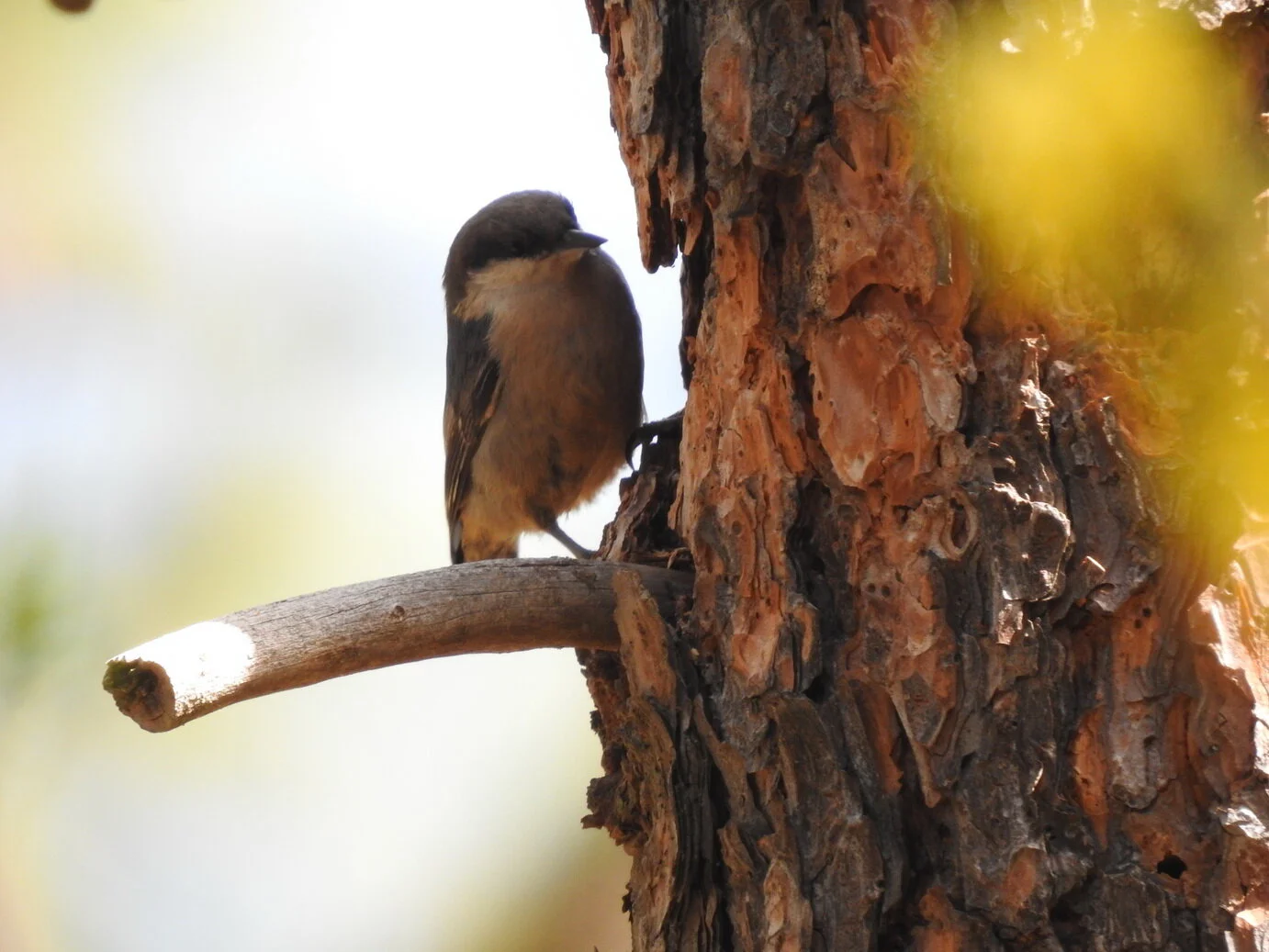
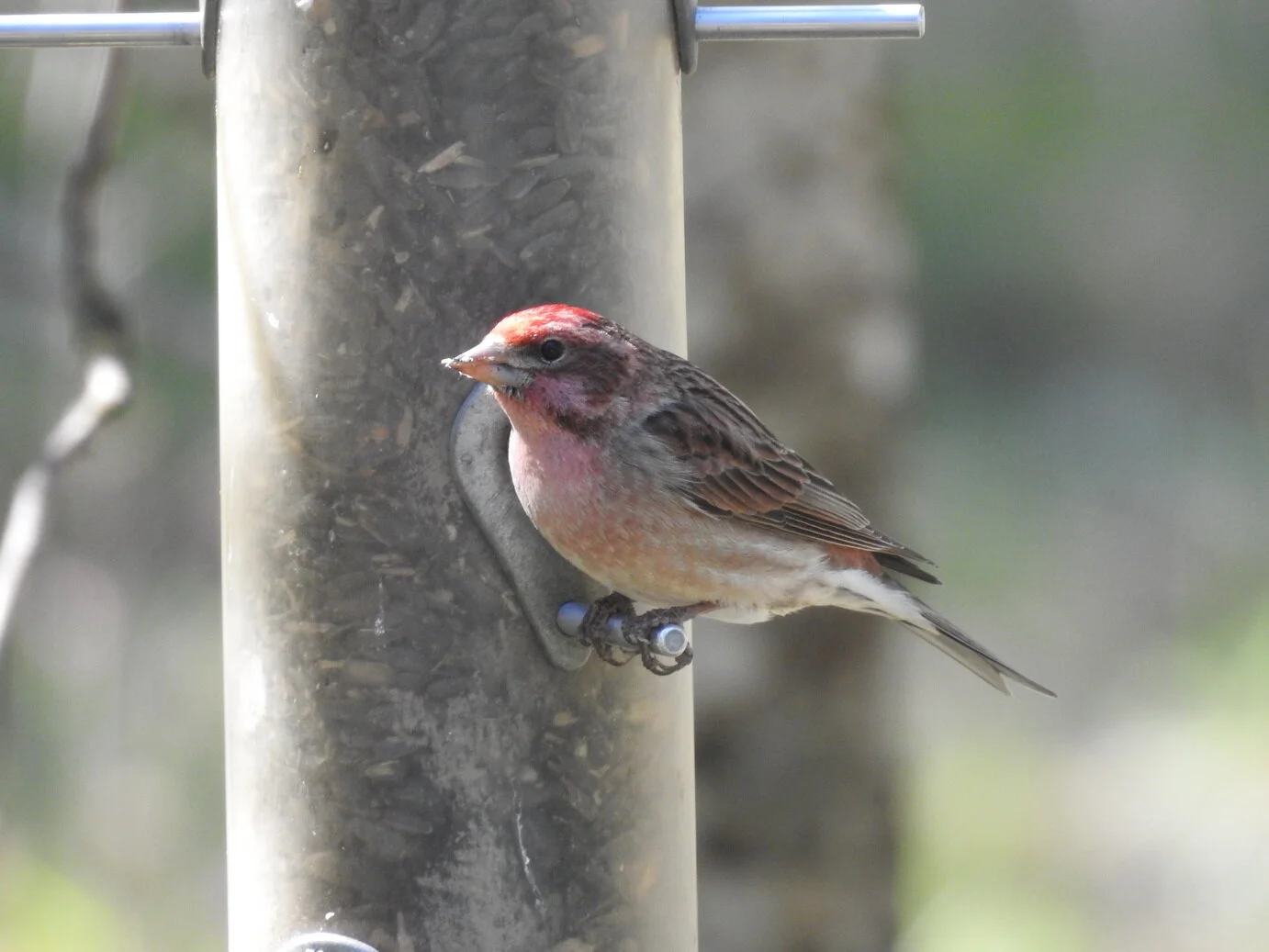
We spotted a Merlin on West Euclid about a week ago, sitting in the top of a ponderosa pine (see photo below). We also have a pair of kestrels hanging out in the neighborhood, which we have never had before.
Bea and Jim Harrison

Nesting Osprey
After a busy day's work on April 17th I drove out to nearby Turnbull National Wildlife Refuge to clear my mind and look for some interesting birds to photograph. I started down the Columbia Plateau Trail that crosses the Refuge and noticed a nearby Osprey. I got some nice photographs as she few off the nest - agitated when a Bald Eagle flew close by - and then returned.
Her nearby mate had joined in the Bald Eagle chase but came back with a fish that he proceeded to eat while perched on a telephone pole. The female was calling out to him for nearly the entire time.
Did you know that an Osprey is also called Sea Hawk, River Hawk, or Fish Hawk as it eats only fish? This raptor can dive as deep as three feet into the water for fish, but prefers to hunt in even shallower areas. It takes both birds 14 to 21 days to complete a new nest. They weigh 3 pounds and they often mate for life. Their typical lifespan is 7 to 10 years.
Carlene Hardt

Goldfinches on Upriver Drive
Pearl Bouchard enjoyed seeing American Goldfinches on Upriver Driver along the Spokane River on April 16th and 18th.


