
Exactly two years ago on this day I was finishing up a letter to Spokane Audubon Society members to explain that we were at a point where we needed to either grow or go back to a previous version of ourselves. Today I realize that the inflection point is more of an extended curve. A lot has happened in these two years, and we still are growing into a more dynamic, collaborative part of our community.
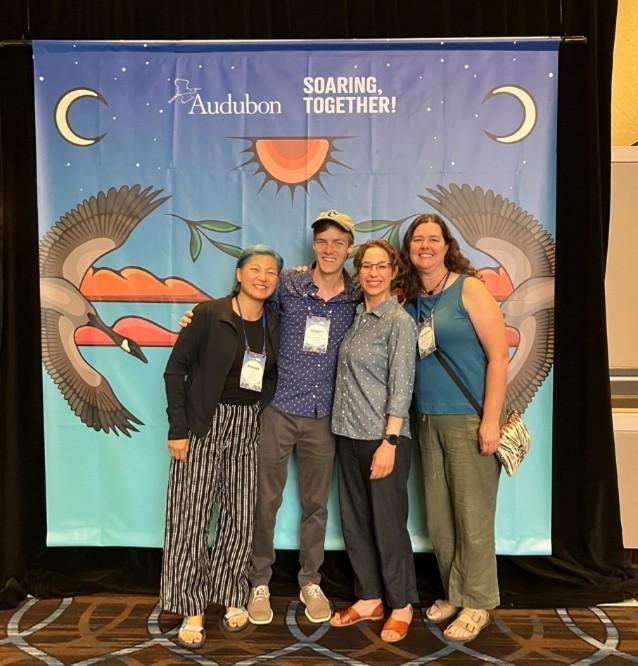
At that time in April 2024, we hired Shenandoah Marr on a part-time contract basis as our Outreach Coordinator. In the two years since, she has written and we have received several grants to help fund our work. She has established strong relationships with all the local conservation organizations and working relationships with other Audubon chapters all over the country. Last summer at her own initiative she attended Soaring, Together!, the Leadership Conference of the National Audubon Society in Montreal and came back jazzed with ideas and connections. These connections are making a difference in our community. At some point last year, a person joined our chapter and when we asked how he had heard about us, he just said “You are everywhere!” Board member Mike Borysewicz recently said he couldn’t imagine Spokane Audubon without Shenandoah. The rest of us on the board agree that Shenandoah has really become the face of Spokane Audubon.
Because she has done so much for us, we decided to hire her as an employee rather than as a contractor. The position is still part-time, but we will be paying her a bit more and taking on the responsibilities that all employers have regarding taxes and fees associated with having employees. Her new position is Program Director as this reflects more of what she actually does.
One of the things that Shenandoah discovered in talking with other Audubon chapters is Constituent Relationship Management (CRM) platforms. These cloud-based platforms are used by companies and non-profits to manage the different relationships that all organizations have – customers, clients, volunteers, other organizations, donors, members, etc. Spokane Audubon, like many smaller non-profits, has its data in what is referred to as “data silos.” Our membership data is kept in a database on my local computer. Our volunteer data is kept in a spreadsheet on Shenandoah’s computer. Our website has contact information that somewhat, but not completely, overlaps all the other data. These data silos do not talk to each other. Any questions that members or board members have must be directed to the person who manages that silo. For example, at monthly meetings at the sign-in table we ask if you’re a current member or not, and at least one person always says “I’m not sure when I last paid my dues.” (and we’re not sure either without accessing the “dues silo”!). A CRM coordinates all that data in one place, which reduces confusion, redundancy and time spent getting the information in and out. CRM platforms allow members and volunteers to view and update all their personal information, including their volunteering, membership status and donations. Starting in November of 2025 a small team began extensively researching CRM platforms. We explored the websites and narrowed the list by talking with other Audubon chapters, local organizations, and agents from several platforms. We then decided to use the Neon One platform as it offers the most bang for the buck. We are excited about getting this tool up and running so that we can serve our members and our community more effectively.
Meanwhile, another small team on our board has been working on a strategic plan. As far as I am aware Spokane Audubon has never had a strategic plan. We thought it was about time we had a plan for what we want to accomplish over the next few years! We do have a mission statement – “Advocating for birds and their habitats in the Inland Northwest and connecting people with nature” – but a strategic plan gives a more detailed set of goals, each with pertinent activities and a timeline for achieving them. The team has almost completed the plan after several months of work and we will soon send a summary to our members.
At a recent meeting I asked a person who has made some large donations to us over the last couple of years, if he would like to direct his donation to any specific project. He thought for a moment and said, “I don’t really know what you do.” That statement has stuck in my mind ever since! We apparently have not done a good job communicating what we are doing with the money that our donors have entrusted with us!
So, if you do not know what we do, here are a few of our activities:
We offer free monthly meetings with programs on all things wildlife, field trips, bird walks and our popular Birds and Brews events. See our calendar: https://www.audubonspokane.org/upcoming-events
We participate in community education events like Earth Day, Earth Fest at Turnbull, Arbor Day at Finch Arboretum, Active Living Expo, farmers markets, and others
We maintain active Facebook and Instagram accounts for community outreach and education on issues affecting birds
We write and submit letters to governmental agencies advocating bird-friendly decisions on habitat protection, land use, and more
We produce an annual calendar featuring members’ bird photographs and local phenology notes and sell them to recover printing costs and add a few dollars to our coffers.
The Save-a-Bird team has recently enlisted new volunteers and is ramping up for another season of assisting injured birds.
We are expanding our Kestrel nestbox project with even more boxes in the field and training more volunteers who will be monitoring the boxes.
The Bird Strike Prevention team is dedicated to installing more window treatments to reduce bird deaths. Window strikes are the number two cause of preventable bird deaths. We have already installed systems on the Dishman Hills Conservancy office, the Doris Morrison Learning Center and the headquarters building at Turnbull NWR. And we currently have more projects at local buildings planned
The Cats Indoors team is committed to educating and persuading cat owners to keep their cats indoors to reduce the number one preventable, human-related cause of bird mortality.
Restoration projects in collaboration with local partners:
The Revere Wildlife Area (Pheasants Forever)
Little Spokane River area (The Lands Council)
Swanson Lakes Wildlife area (Pheasants Forever)
Expansion of a local native plant nursery to grow native plants for local restoration projects (Inland Northwest Land Conservancy)
We received a recent grant that tasks us over the next 3+ years to remove toxic lead from waterways in the Inland NW in collaboration with the Upper Columbia United Tribes and Spokane Riverkeeper.
Land Acquisitions in collaboration with local partners:
Dishman Hills Conservancy (Wilson property) - $10,000
Inland NW Land Conservancy (Glen Tana property) - $10,000
Dishman Hills Conservancy (Phillips property) - $5,000
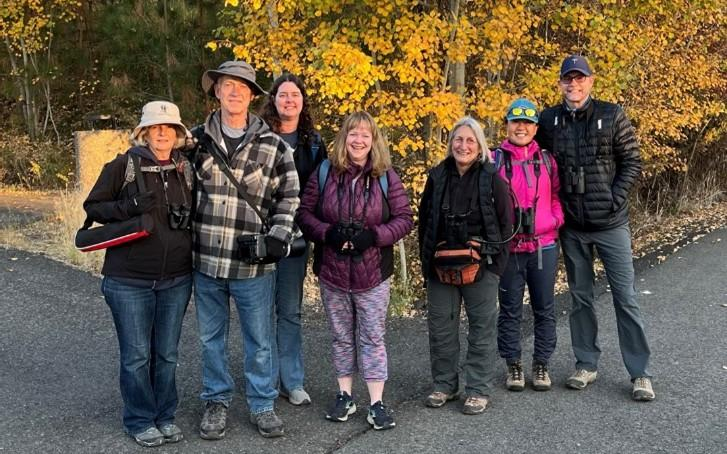
I joined Spokane Audubon when we moved to Spokane in 1981. I quickly realized that I had found a home with a fun and welcoming group of people who shared my interest in birds and conservation. I don’t recall exactly what membership cost at that time, but I think it was $15 for an individual. By around 2000 it went up to where it is today, $20. That $15 in 1981, accounting for inflation, would be $54.49 in 2026! We have always wanted to keep memberships accessible to everyone. The fact of the matter is that we don’t charge for anything we offer (calendars excepted). So why become a member of Spokane Audubon Society? I can’t answer for everyone of course, but I suspect people become members just to support birds and wildlife. That is why I have always been a member. I support Spokane Audubon because I am passionate about birds and wildlife and Spokane Audubon does what I cannot do alone.
Our membership tiers have remained largely unchanged for decades, but Spokane Audubon is a vastly different organization than it was even just a few years ago as I described earlier in this letter. Our ambitions and reach have expanded, and we want to do even more for local wildlife. We know that the Spokane and Eastern Washington community can support a more robust, locally-focused Audubon chapter. Over the next few months, we on the board will be looking to revise our membership tiers to reflect current commitments and projects and current costs, while keeping the cost of membership affordable. If you have thoughts about this, I and my fellow board members would love to hear from you. We want to build a stronger and more effective voice for wildlife together.
Thank you for being part of the Spokane Audubon Society!


