
One of Spokane Audubon Society chapter founding members Jan Reynolds passed away September 27 at the age of 84. At the time of this writing, no memorial services were planned. We remember Jan -- the educator, naturalist and artist who designed our Pygmy Owl logo – with the following member profile of her and her husband and fellow chapter founder Ed that ran in the December 2019 Pygmy Owl newsletter edition.
In 1969, the Spokane Bird Club became the Spokane chapter of the National Audubon Society. In commemoration of our 50th anniversary, we’re profiling some of our early, long-serving board members.
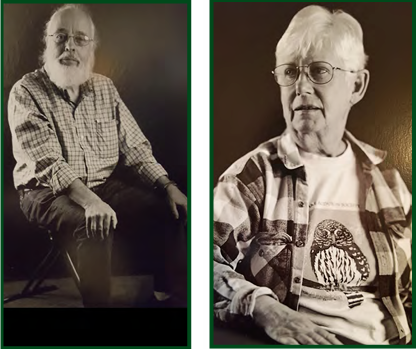
Jan and Ed Reynolds
When Jan and Ed Reynolds moved to Spokane in 1968 to leave the increasing congestion of the San Francisco Bay area behind, they immediately looked for the local birding community to continue their shared interest.
They found the Spokane Bird Club and teamed up with them to create the Spokane chapter of the National Audubon Society. Both Jan and Ed were on the initial board of directors, and they designed, wrote, mimeographed, and mailed copies of the newsletters for the first few years.
Jan, who has sketched birds and other wildlife since she was a child, drew a Northern Pygmy Owl to put on the masthead and name the newsletter. “We didn’t bother going through the bureaucracy of a board vote on that,” Jan recalls with a mischievous smile. But since another founding member, Warren Hall, often used Pygmy Owl calls on field trips for attracting birds to attack the predator, eventually everyone figured it was a good icon.
Jan says that sketching is how she learned birds. “I’ve always loved drawing, and you have to look at them carefully enough to be able to draw them accurately,” she explained.
Jan Nicholson was born in 1940 in the San Francisco Bay area, interested in the natural world since the age of three, collecting caterpillars in jars to watch them turn into butterflies. She left her family of Jehovah’s Witnesses, who don’t believe in college education, at age 17 to educate herself and found a work “niche” painting the lettering on test equipment manufactured by Hewlett Packard in Palo Alto.
Ed was born in 1938 in Lead, South Dakota, and lived in other small towns in Wyoming, Montana, Idaho and Washington. After high school he joined the U.S. Navy where he learned to be an electronics technician. After the service he worked for Boeing in Seattle, but soon longed for a warmer, drier climate. He took a job with Hewlett Packard in Palo Alto and joined the company choir in 1960 where he sang bass and Jan sang alto.
In 1962, they both participated in a party celebrating the 100th anniversary of climbing in the Sierra Nevada Mountains. In traveling from sea level to 13,000 feet, Jan noticed all the different life zones and bird species, from gulls to ravens, and realized that she didn’t know what most of them were. The next day she went into the Yosemite National Park visitors’ center and bought a copy of the first Roger Tory Petersen bird field guide and checklist. Ed bought her a pair of heavy-duty Sears Roebuck binoculars and they began driving to places to watch birds. Jan was hooked – both on birds, and on Ed. They married in 1963 and nature became a big part of their lives.
Ed made a big terrarium for Jan’s collection of insects, reptiles and amphibians to study and draw. Together they learned all the shorebirds and waterfowl in the migration corridor of the Bay area. When they found an injured bird, they took it to the Point Reyes National Seashore Observatory, where they learned of and helped with mist-netting and bird-banding work. That data collection, Ed proudly recalls, eventually determined the value of that flyway and led to removal of the area’s sprawl of vacation homes.
Sprawl in the Bay area in general had them longing for smaller town life. After earning an English teaching degree from San Francisco State College, Ed looked for work in Washington where his family lived, and landed a job with Spokane Falls Community College (SFCC). There Jan started taking biology classes at night (after caring for their daughter during the day while Ed taught.) SFCC entomologist Laurel Hansen befriended student Jan, who ended up illustrating her book on carpenter ants. Jan later created The Little Spokane River Journal, produced by Spokane County Parks, SFCC, Spokane County Conservation District, and Spokane Audubon. Jan contracted with St. George's, Orchard Prairie, and other schools to conduct environmental education programs, including field trips to the Little Spokane River, Nature Mapping projects, and other ways to teach thousands of youngsters "how everything is connected to everything else."
Though the Reynolds' home in south Spokane County near the Iller Creek Conservation Area is rich in bird life, they have traveled the continent to see birds. Ed has always been interested in "Edward Abbey country," so they visited most refuges, parks and other public lands in the southwest in their camper. They helped with mist-netting warblers and woodcocks off the Rhode Island coast while visiting Ed's sister. They also love spring birding the Texas Gulf Coast, Malheur National Wildlife Refuge in southeast Oregon, and Costa Rica.
One of Ed's favorite birds is the common yellowthroat, which he knows well from fly-fishing western beaver ponds and which Jan painted for him. One of Jan's favorites is the white-throated sparrow, whose "magical" song she heard a juvenile mastering one spring in their yard.
The Reynolds' advice to new birders is simple: get out there to look and listen, and be around experienced birders to learn. Both note that Spokane Audubon founders like Tom Rogers, Warren Hall and Morey and Margaret Haggin have been their mentors. They’re concerned about current rollbacks of environmental protection, habitat loss, and overall climate change impacts on bird diversity and numbers. "I worry whether we're going to have sustaining food chains left," Jan said. "When there are no insects, there are no birds, and eventually that's a threat to all of us."
Both feel Spokane Audubon has been good about keeping environmental awareness alive in the community and hope the environmental education efforts of members like Joyce Alonso, Lindell Haggin, and others continue.


