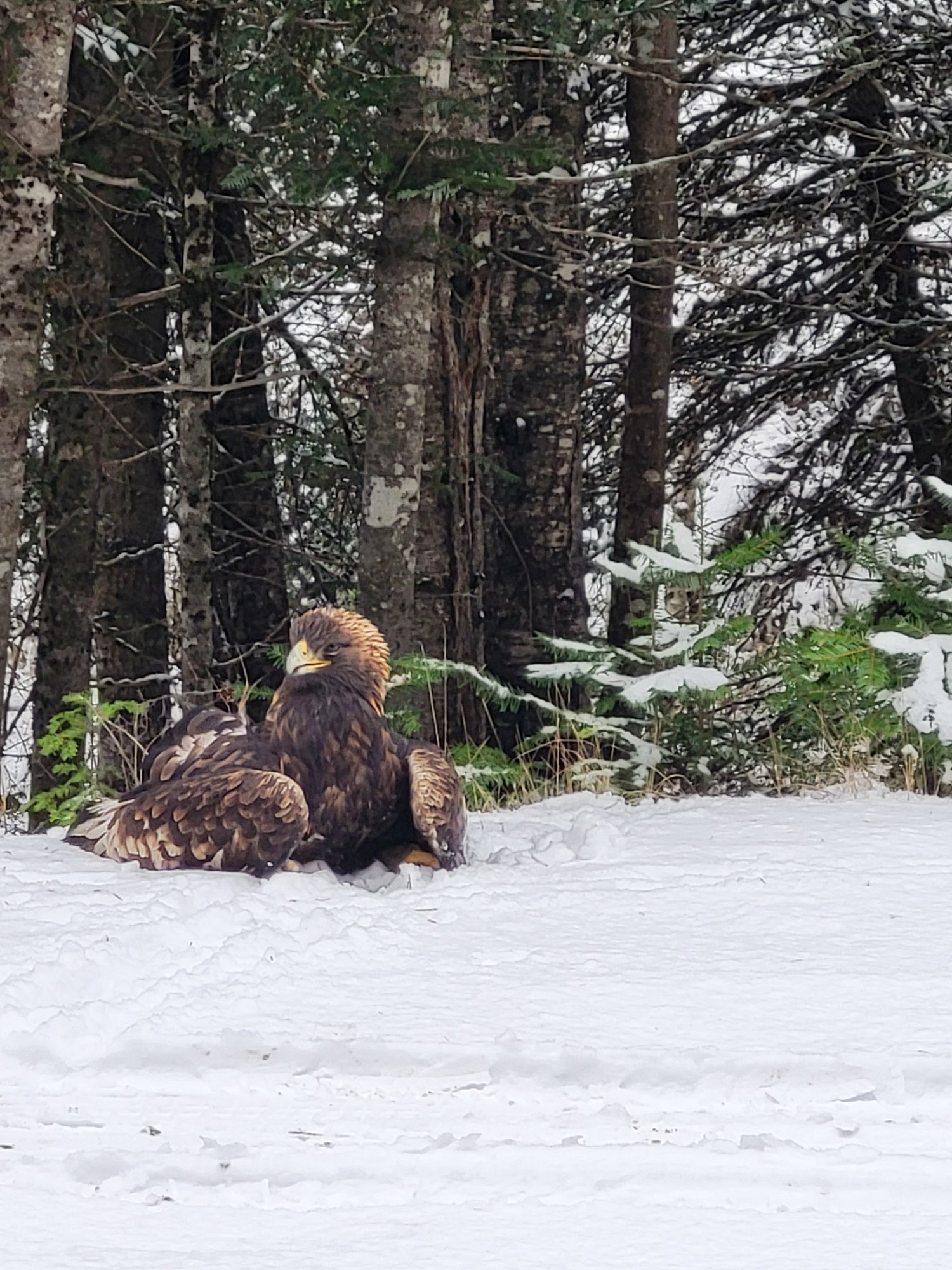
Image above: Injured golden eagle captured in the Newport area by Margo Wolf on December 3, 2025.
This year, volunteer team members logged more than 300 hours responding to 420 reports from the public regarding injured, sick, or vulnerable birds. The team handled most of these incidents by providing advice / coaching to the reporting party over the phone. A total of 99 separate incidents required physical intervention by team members. Often, these involved capturing and transporting injured birds to cooperating veterinarians. Our volunteers drove almost 5,500 miles to complete physical interventions with wild birds this year.
Notable success stories this year included the rescue of a saw-whet owl that had become trapped underground in an uncapped septic pipe on the National Park Service’s Fort Spokane property. Bea and Jim Harrison were able to get this bird to grab onto a small branch they lowered into the pipe, which they then slowly pulled up with the bird attached. Once freed, the bird promptly flew to a nearby bush, unharmed. The Park Service maintenance crew has promised to cap the septic system openings at Fort Spokane to prevent future entrapments.
Another incident involved an immature bald eagle found on the ground in the Newport area. This bird was under-weight and weak when Sara Callan-Boggs found it. Sara captured the bird and transported it to Spokane, where she transferred it to Heidi Webb. Heidi then drove it to the Wildlife Ward at WSU’s Veterinary School in Pullman. WSU recently provided us with an update on this bird. The reason for the bird’s condition could not be determined, but the vets were able to nurse it back to health. They eventually released it on the Methow River in North Central Washington, a wintering area for bald eagles. This bird now sports an identifying leg band.
Team members transported 57 individual birds to cooperating veterinarians in 2025. These included five bald eagles, two golden eagles, 14 great horned owls, and 13 other raptors. Of all the birds the team transported, 45 were not treatable due to the extent of their injuries and either died or were humanely euthanized. Ten birds were treated by the vets and ultimately released. We have not able to ascertain the fate of two birds we transported.
If you have questions regarding the team’s efforts this year, or if you are interested in volunteering with the team, please contact:
Margo Wolf ml12722@icehouse.net or
Mike Borysewicz maborysewicz@gmail.com


