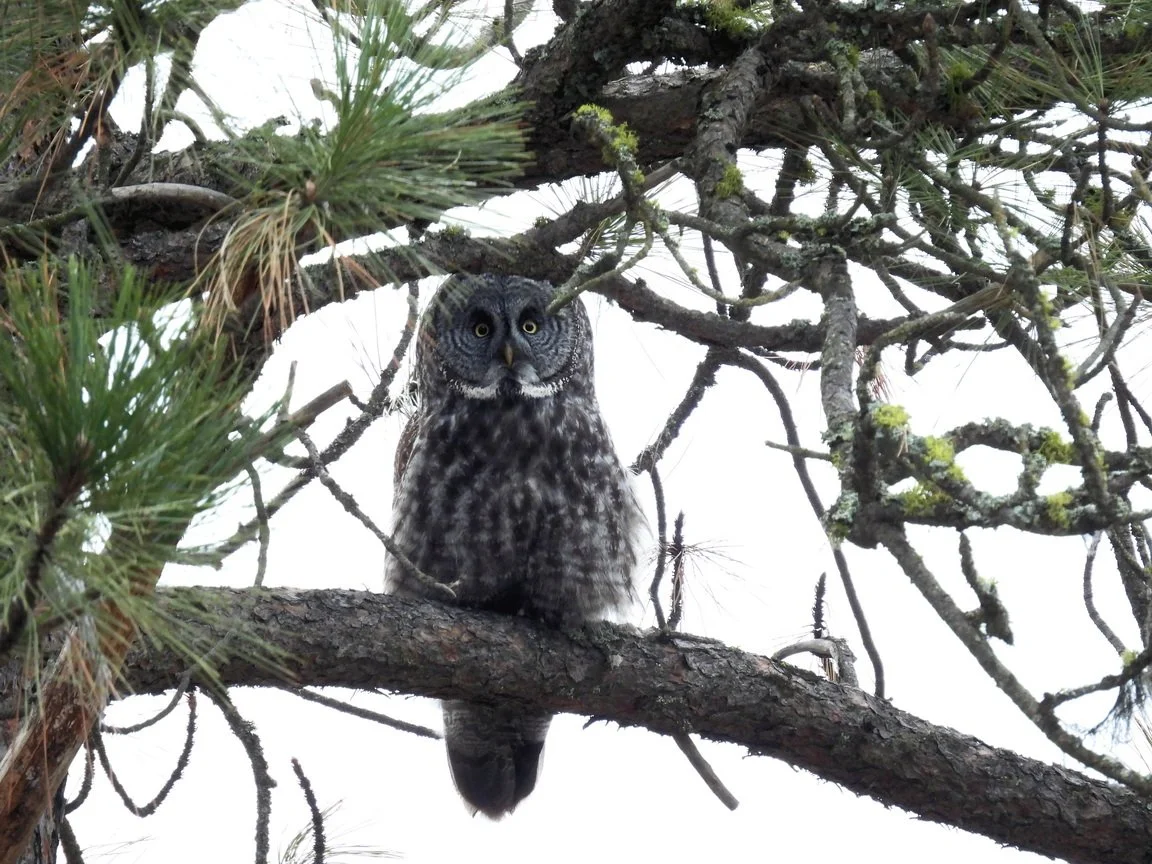
By now, most birders in the region have likely heard about this recent, uncommon visitor to Turnbull National Wildlife Refuge. Great gray owls are the largest owl species in North America, having a wingspan of up to five feet. They inhabit bogs, grassy meadows and boreal forests, where they feed mainly on small mammals such as voles. When vole populations crash, the birds can move in large numbers south of their usual range, particularly in the winter.
Once word got out that this bird was sighted on the refuge, someone posted a detailed location for where it was last seen on Facebook. This report prompted something of a viewing frenzy, attracting many birders, photographers, and others to the refuge. Reportedly, the owl was intentionally disturbed off its daytime roost by some person(s) wanting to obtain pictures of the animal in flight. Under the Migratory Bird Treaty Act and Washington State law, it is illegal to injure, harass, kill, or possess birds of prey. Disturbing a roosting or nesting owl can be particularly detrimental to the bird. Uncommon owl species such as great grays, hawk owls, and snowy owls can unfortunately be subject to disturbance and harassment by people, especially in this age of quick information sharing on social media.
If you witness wildlife being disturbed or harassed, or other illegal activity on public lands such as resource damage or vandalism, please report it to the appropriate land managers. You will need to know what property you are visiting (ex., national wildlife refuge, national forest, state park, etc.).
Cassie Roeder, Turnbull National Wildlife Refuge Manager, states that tips from the public are invaluable in resolving cases of illegal activity. She stresses that "actionable data" is needed; a vehicle description (ex., red Ford pickup), and plate number (with the state of issue) are ideal. She cautions to never confront anyone, but if you can, discretely jot down the information or take a photo. If there are multiple vehicles present, record as much data as you can. You never know what might prove useful to an investigation.
As birders, we owe it to the resource to be as thoughtful and ethical as we can in our pursuit of that next “cool” bird sighting or photograph.


