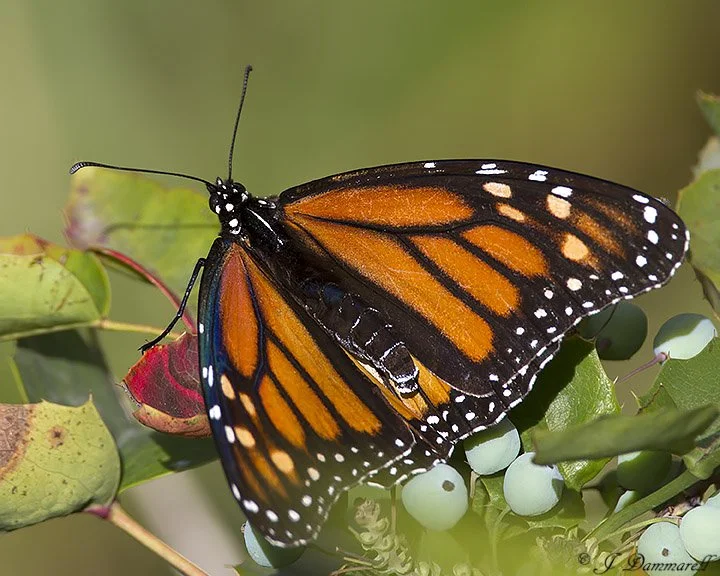
Our February meeting program on citizen scientist volunteers tracking captive-reared telemetry-tagged Monarch butterflies to help determine migration routes, presented by Patrik Adair of the North Idaho non-profit organization WingsRising, Inc., raised a lot of enthusiasm and questions about Washington state efforts.
Our program chair Gary Lee contacted the Washington Department of Fish and Wildlife (WDFW) and learned that Dr. Julie Combs is the state’s pollinator species lead biologist. Dr. Combs told him that release of butterflies (or any other kind of wildlife) reared in captivity is regulated to avoid potentially negative effects to wild populations from disease transfer, interference with ongoing monitoring and conservation efforts, and potential for genetic dilution of wild populations.
She noted there are three Washinton Administrative Codes (WACs) that are relevant:
To release butterflies one would need a letter from the director (WAC 220-450-010). The request would need to include details such as the location, number of butterflies, etc., and how concerns regarding disease, genetic contamination, and interference with other researchers’ monitoring efforts would be addressed.
To collect monarchs at any life state one would need to attain a scientific collection permit (https://wdfw.wa.gov/licenses/environmental/scientific-collection) (WAC 220-200-150) and include the research plan, outcomes etc.
To take wildlife, including butterflies, out of the wild is unlawful without a permit (WAC 220-450-030).
She also referred to two blogs from leading non-profit conservation groups addressing concerns with captive release of butterflies – the Xerces Society at https://xerces.org/blog/keep-monarchs-wild, and the Washington Butterfly Association at https://wabutterflyassoc.org/rearing-and-releasing-butterflies-in-washington-state/.
Dr. Combs said the two best things that people can do right now to support monarch conservation in Washington is first to create habitat without harmful pesticides, and second to participate in community science efforts to document monarch occurrence.
Monarch habitat includes shade structure, nectar sources, and host plants (native milkweed). Dr. Combs will send us some seed packets for eastern Washington native milkweed and mixed native pollinator nectar plants for distribution to interested members. She also noted the following resources for more information on habitat development:
· Western Association of Fish and Wildlife Agencies: Western Monarch Conservation Plan (https://wafwa.org/wpdm-package/western-monarch-butterfly-conservation-plan-2019-2069/).
· Xerces Society: https://xerces.org/publications/fact-sheets/how-you-can-help-western-monarchs
· Xerces Society: Managing Monarch Habitat in the west: https://xerces.org/monarchs/western-monarch-conservation/habitat
· Xerces Society: Habitat Kit Program: https://xerces.org/pollinator-conservation/habitat-kits
Dr. Combs said monarch community science is very important because WDFW alone doesn’t have the capacity to document all life stages (eggs, larvae, adults) and available milkweed habitat. Information gathered through the following projects feeds directly into the state’s database and helps inform management, conservation planning, and status assessments.
· iNaturalist (https://www.inaturalist.org)
· WDFW at-risk reporting app (https://survey123.arcgis.com/share/a384e90f69744f2e846135a9ce80027f)
· Monarch Milkweed mapper (https://www.monarchmilkweedmapper.org/)
Gary hopes to book Dr. Combs in next season’s monthly program line-up to present more on the Washington efforts to conserve Monarch butterflies, so stay tuned.


