Herons... Oh, the Beautiful Herons!
By Liz Melville
The Questioning Quail
@thequirkyquestioningquail
Jul 19, 2026
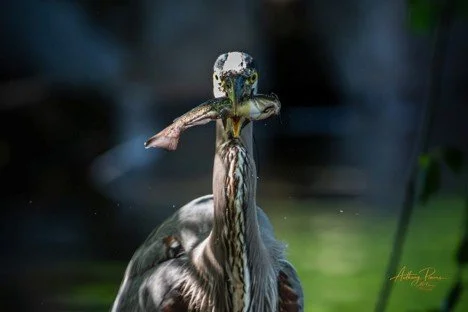
Anthony Pimms, one of the photographers who spent hours at the duck pond, shared this photo with me. You can purchase a copy of this image or one of his other spectacular photos by visiting his website: https://www.apfocusphoto.com. Please don’t use this picture without his permission.
Four almost-adult Great Blue Heron chicks call out in a raucous chorus--click, clack, clickty, clack, clack-- I’m so hungry, feed ME, feed ME, feed ME!
One of the gangly adolescents is in distress. It climbed onto a branch above the nest and can’t figure out how to get down to where the parent is feeding its siblings. It shuffles sideways, reaches its long neck down towards the parent, and then, in all of its hungry panic, stumbles, squawking loudly as it falls to a lower branch.
I recorded this scene with my iPhone from a viewing spot where I spent much of last spring with Anthony, Vincent, and Ron, all photographers who had been watching and taking pictures diligently since the herons first built their nest high in a Ponderosa Pine tree above the Manito Park duck pond.
The duck pond had become my hang out. The place my family would know to look for me when they had not seen me for hours. The place where in March I heard:
GHOOONK, GHOONK, GHOOONK--a deep guttural, almost croaking call from three Great Blue Herons flying directly overhead, where I saw their tangerine-orange, sharp beaks leading long, outstretched necks powered by wings as long as I am tall. They were scoping things out, deciding if it was a good place for a nest.
Most of the spring, I observed the heron family a few days a week during short walks where I would look through my binoculars to check if the parents were still tending to their nest. I had not yet become a true fan like the dedicated photographers who were camped out for hours each day with their cameras.
It was during one of these casual walks that I asked one of them, “When do you think they will hatch?”
“They already have,” Ron responded, offering a view through his camera. Sure enough, I could see fluffy heads perched on long necks just above the nest’s edge.
These photographers were like this--generous, kind, happy to show anyone who was interested a view through their lenses.
It wasn’t until the babies were 7-8 weeks old that I became one of the regulars. At this point, I could see the youngsters well with my binoculars and became enthralled by the their daily antics: their play beak fights that looked like sword fights; their discordant calls at feeding time--so loud, anyone anywhere near the duck pond would hear them; their beginning explorations--like those of a toddler--where each baby climbed up and around the tree with the assistance of wing flaps, their practice flights on the edge of branches where they would rigorously flap their wings; and their post-feeding happy dances.
It wasn’t until I was fully invested that I became awed by the heron parents: their ability to build a nest that supported four babies that grew to be more than three feet tall; their patience in taking turns sitting on their eggs for almost a months waiting for them to hatch; their diligence to find enough food to feed four ravenous growing beasts; and their ability to keep track of each of the babies as it left the nest. (At one point, when 3 of the 4 babies had fledged, I returned early in the morning and all 4 of them were gathered back at the nest.)
During this time, when the heron youngsters could be seen and heard from anywhere around the duck pond, they became the darlings of the park. People would stop and ask questions of the make-shift heron “experts” and watch the adolescent shenanigans in and around the nest through borrowed binoculars or camera screens. Even a local journalist from the Spokesman Review, Elena Perry, wrote an article on the herons. It ran on the same day the paper printed the news about a devastating wildfire that had dipped into the city, killing a person and destroying 15 homes—perhaps to highlight one positive thing amidst so much loss.
The herons’ story is spectacular, but it is just one of many miraculous bird and animal stories. If a person takes the time to listen and watch, they might see a Red-breasted Nuthatch climb face first down a pine tree as it scampers to glean bugs from the bark; an American Robin stop as it hops through the grass, knowing just the right place to peck for a worm; or a Red-tailed Hawk dive from its high glide to catch a rodent it spotted from 100 feet away.
And if a person is curious enough, they might read and learn that migratory birds use the position of the sun and stars along with earth’s magnetic field to navigate flights often spanning thousands of miles, Burrowing Owls have a smart solution for attracting food to their nests, and Cactus Wrens builds nests in the protective cover of prickly cacti in a design that shields their young from the sun.
What makes the herons’ story unique is that it took place in a beloved park in a visible location. By nesting here, the herons were more than just birds to read about--they became real, loved members of the community--beings to talk and ask questions about.
My dream is that by hearing and seeing the miracles of the herons, people will gain an emotional, tangible connection to the natural world. A connection that will make them pause before clearing trees at their lake places so they can have a better view of the water, think twice about using poison to kill mice or other rodents (a food source for hawks, owls, eagles, crows, and sometimes opportunistic herons), and provide a reason to donate to a conservation non-profit, so there are conditions that support the lives of all of earth’s creatures.
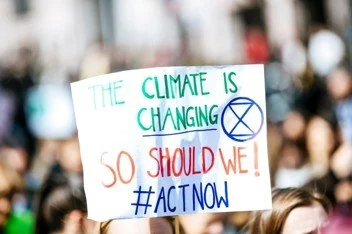
Photo by Markus Spiske on Unsplash
Small Change-A Call to Action
I woke up this morning (July 17, 2026) to a purple haze. According to AirNow, the air quality in Spokane is hazardous. The app recommends that people stay indoors and reduce their activity.
Awful news for residents around the Inland Northwest. We will either be cooped up inside or have to wear mask until the air is safe to breath again.
But what about my chickens? What about the robins on my porch? What about the beloved herons I just spent the spring watching? They can’t escape the heat and the smoke.
If the summer smoke season, the higher temperatures, the lack of winter snow, the rapid extinction of species is not a call to action, I don’t know what will be? Climate change is real. It is time to take it seriously. It is time to make changes.
Thoughts:
It is really easy to throw up one’s hands and to believe the small things we do don’t matter, especially since so many big moving pieces seem to be out of control. But we are a part of the system. What we do matters.
It is easy to point fingers and to look to what our government or our neighbors should do. But looking inward is more productive. And each of us can make changes that work in our own lives.
I am focusing on a few small things:
• ride my bike and take the bus more.
• Be careful with my water use—in Spokane the aquifer and river are interconnected and our river is low. Water conservation matters.
I invite you to join me in choosing to make some small change that impacts climate change.
AND—please vote. This mid-term election matters!!
Liz Melville originally posted this on her Substack: https://questioningquail.substack.com. Please visit her there for more of her writings.


